Here's a question that haunts every gardener: "How often should I water?" It seems simple, but the answer is surprisingly counterintuitive. The question itself might be wrong. What you should be asking isn't how often — it's how deeply.
The difference between watering often and watering deeply is the difference between a garden that's constantly stressed and one that's resilient. It's the difference between roots that sit near the surface, gasping for every drop, and roots that reach deep into the soil, finding water on their own. And once you understand the principle, it changes how you approach every aspect of garden care.
The Root of the Problem
Roots are not passive. They don't just sit in the soil and hope for the best. They grow toward water. This is the fundamental fact that makes deep watering work.
When you water lightly and frequently — a quick sprinkle every day — the water only penetrates the top inch or two of soil. The roots of your plants, being smart, grow where the water is: near the surface. You've trained them to be shallow. Now your plants are dependent on you for daily water, because their roots are in the driest, hottest part of the soil. Skip a day and they wilt. Go away for a weekend and they're in crisis.
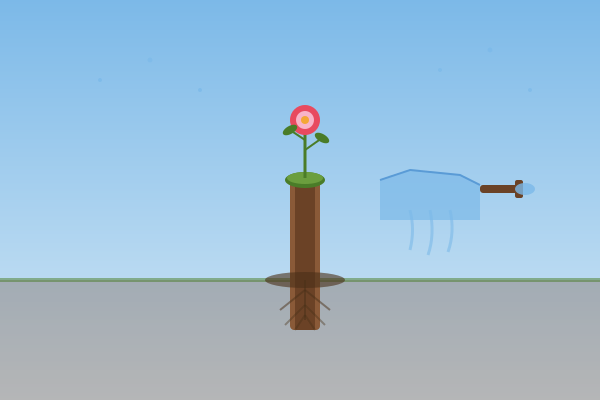
When you water deeply and infrequently — a long, slow soak once or twice a week — the water penetrates 6 to 12 inches into the soil. The roots follow the water down, exploring deeper, cooler, more consistently moist layers. Now your plants are self-sufficient. They can go days between waterings. They're drought-tolerant because their roots are in a zone that stays moist even when the surface dries out.
You're not watering plants. You're training roots. Every time you water, you're telling the roots where to grow. Make sure you're sending the right message.
What "Deeply" Actually Means
A deep watering means applying enough water to moisten the soil to a depth of 6–12 inches for most garden plants (deeper for trees and shrubs). That's significantly more water than most people apply in a "quick watering."
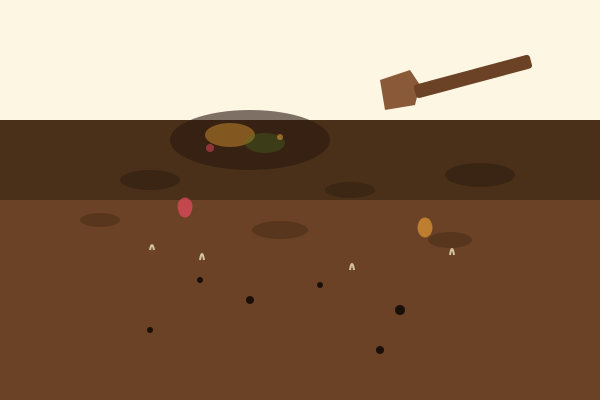
Here's the practical test: after watering, dig down with a trowel. If the soil is only moist in the top 2 inches, you didn't water deeply enough. If it's moist down to 6+ inches, you did it right. This test is worth doing once — it'll recalibrate your sense of how much water "deeply" requires.
As a rough rule, 1 inch of rainfall or irrigation penetrates about 6 inches into loamy soil. So a deep watering is roughly equivalent to 1–1.5 inches of rain, applied slowly enough that it soaks in rather than running off.
Set a straight-sided can (like a tuna tin) in the garden while you water. When there's 1 inch of water in the can, you've applied enough for a deep watering. This is the simplest, most reliable way to measure irrigation — no gadgets needed.
How to Water Deeply
The challenge with deep watering is that it requires patience. Turn on a hose at full blast and the water runs off — especially on sloped or compacted soil — without penetrating. Here are the methods that work:
Soaker Hoses and Drip Irrigation
These deliver water slowly at the soil surface, giving it time to soak in. Run a soaker hose for 1–2 hours to achieve a deep watering. Drip systems with emitters are even more precise — you can deliver water directly to the root zone of each plant. Both methods have the added benefit of keeping foliage dry, which reduces disease.
The Hose at a Trickle
If you don't have irrigation, lay a hose at the base of a plant and turn it on to a slow trickle. Leave it there for 15–30 minutes per plant. It's tedious, but effective. You can move the hose from plant to plant while doing other garden tasks.
Watering Wand or Breaker
If you water by hand, use a watering wand with a breaker (the shower-head attachment that softens the flow). Water one area thoroughly, move on to the next, then come back and water the first area again. The first application opens the soil surface; the second penetrates deeply. This "water twice" approach is how you achieve depth with hand watering.
How Often Is "Infrequently"?
This depends on your soil, climate, and the plants themselves, but here are general guidelines for established plants:
| Plant Type | Frequency | Notes |
|---|---|---|
| Vegetables | 1–2x per week | More in heat; tomatoes need consistent moisture |
| Annual flowers | 1–2x per week | Shallow roots; can't go as long between waterings |
| Perennials (established) | 1x per week | Many are drought-tolerant once established |
| Shrubs (established) | 1x every 2 weeks | Deep roots; rarely need supplemental water |
| Trees (established) | 1x per month | Very deep roots; only water in drought |
| Container plants | Daily in summer | Exception: containers need frequent watering |
The Exceptions
Deep, infrequent watering is the rule for established in-ground plants. But there are exceptions where frequent, lighter watering is correct:
New Transplants and Seedlings
Baby plants have tiny root systems. They can't reach deep moisture, and they can't go days between waterings. Water them frequently (daily in hot weather) until they're established — usually 2–3 weeks for transplants, 4–6 weeks for trees and shrubs. Then transition to deep, infrequent watering.
Container Plants
Containers are a different world. The soil volume is small, drainage is fast, and the soil heats up, accelerating evaporation. Container plants often need daily water in summer. This isn't "shallow watering" — you still water until water runs out the drainage holes — but the frequency is necessarily higher. See our container gardening guide for the full picture.
Cool-Season Crops in Heat
Lettuce, spinach, and other cool-season crops have shallow roots by nature. When temperatures rise, they need consistent moisture — sometimes daily — to prevent bolting and bitterness. Deep watering is still better than sprinkling, but the frequency must increase.
The Mulch Multiplier
If deep watering is the strategy, mulch is the force multiplier. A 2–3 inch layer of organic mulch (straw, shredded leaves, bark, compost) dramatically reduces evaporation from the soil surface. It keeps the soil cooler, which means less water loss. And it suppresses weeds that would compete with your plants for moisture.
Mulched soil can go twice as long between waterings as bare soil. If you're watering deeply and still finding your garden dries out too fast, the answer is almost always: more mulch.
Reading the Signs
Plants tell you when they need water, but you have to know what to look for — and some signals are counterintuitive:
- Wilting — The obvious sign, but check the soil before watering. Wilting in hot afternoon sun with moist soil is normal — the plant can't take up water fast enough. If it's still wilted in the morning, it needs water.
- Leaf curl — Leaves curling inward, especially on tomatoes and peppers, signals water stress before wilting appears.
- Color change — A slight grey-green or bluish tint to leaves (particularly on hostas and hydrangeas) is an early drought signal.
- Footprints remain — Walk on your lawn; if your footprints stay compressed for more than a few seconds, the grass is drought-stressed.
The Bottom Line
Water deeply, water infrequently, and mulch heavily. That's the formula for a resilient garden. Your plants will develop deeper root systems, become more drought-tolerant, and need less of your attention over time. You'll save water, save time, and grow stronger plants.
The hardest part is unlearning the habit of daily sprinkling. It feels responsible — like you're taking care of your garden — but you're actually creating dependence. Trust the deep watering approach. Let the soil dry between waterings. Watch your plants reach their roots down and stand on their own. A garden that can survive a week without you is a garden that's truly thriving.
For more on growing in containers (where watering rules differ), see our container gardening guide. For soil-building strategies that improve water retention, check our composting guide. And for seasonal watering adjustments, our planting calendar covers what to do each season.

We write practical, encouraging gardening guides for home gardeners. Every article is rooted in real experience — and a deep belief that everyone deserves a joyful outdoor space.